
The gold case caught the light differently than anything else in the college bookstore.
It was 1987. I was finishing my business degree at the University of North Carolina at Wilmington, and the finance professor had been unequivocal: you will need a Hewlett-Packard 12C. Not a Texas Instruments. Not a Casio. The HP-12C. He said it the way a carpenter might say Estwing or a surgeon might say Wüsthof. There was no discussion.
I remember the weight of it. The buttons had a click that felt deliberate, almost mechanical, like the calculator was paying attention. The machine didn’t conform to you. You conformed to it.
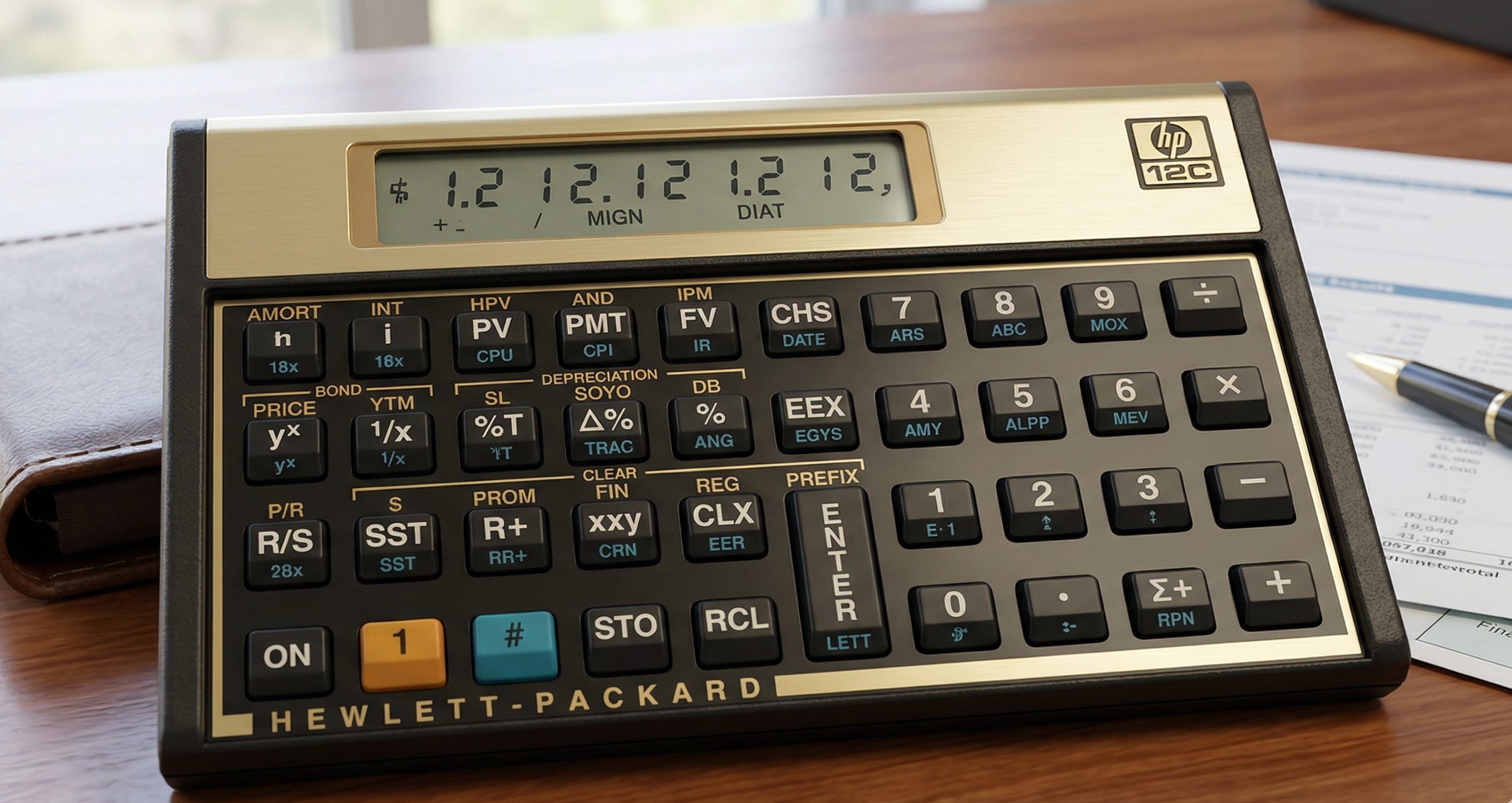
I still have that HP-12C. Not a replica. The original. It sits in my home office alongside nearly a hundred other personal technologies I’ve used firsthand over four decades. It was introduced in 1981. It is still in production today. You can buy one right now at Walmart for $51.95. Every Walkman, every Betamax, every Commodore 64 from that era is a museum piece or landfill. The HP-12C is simultaneously on Wall Street desks and in Walmart shopping carts. In 2026.
Here’s the detail that made me write this article. HP’s own market research discovered in the late 1980s that users didn’t trust answers that came too quickly. So the company deliberately never increased the processor speed. They slowed the math down so humans would believe it.
Hold that thought.
The Word Before the Machine
Here’s what I’d bet most people reading this don’t know: the word “calculator” used to be a job title.
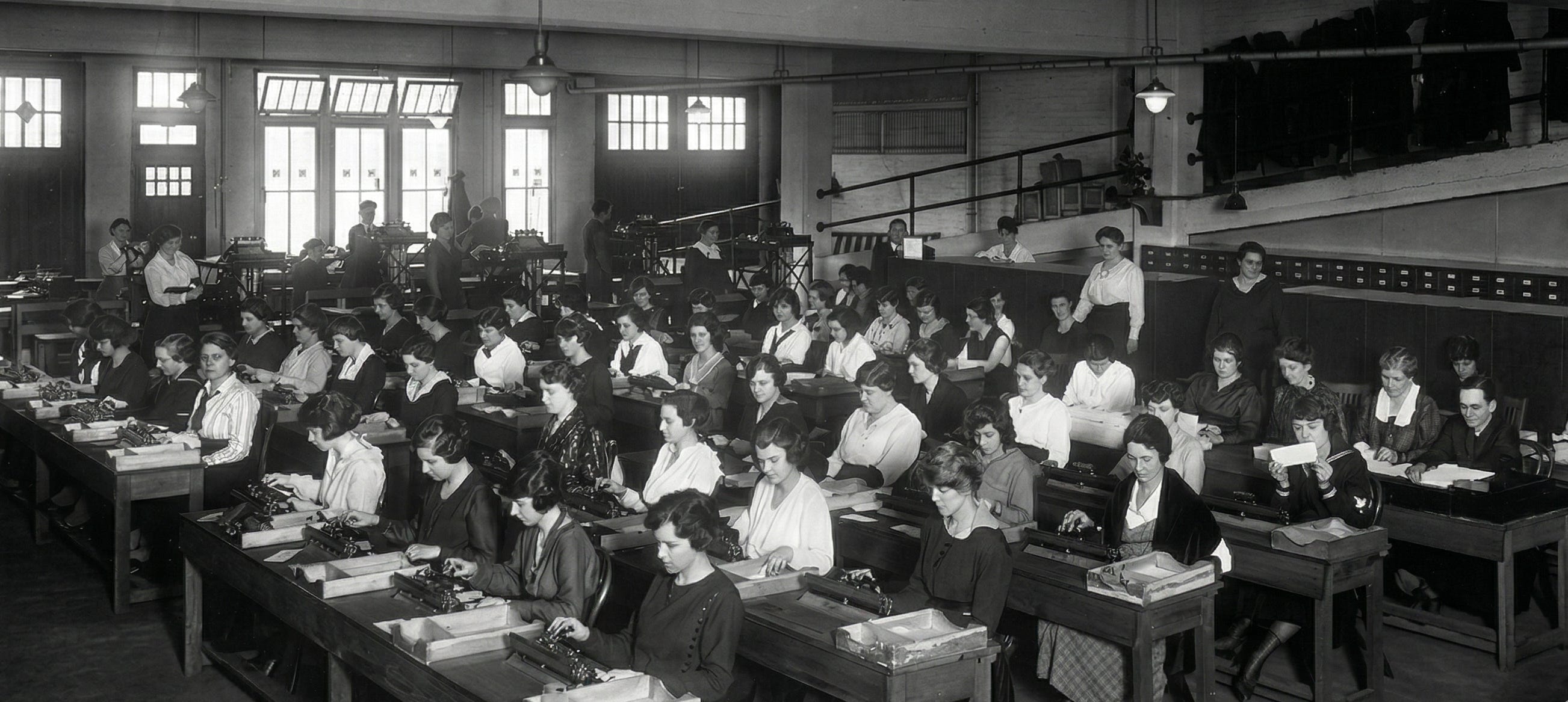
Not a metaphor. An occupation. Before the machines existed, calculators were people. Skilled, trained human beings who sat in rooms and did math with pencils, printed tables, and slide rules. In English, French, Italian, and Spanish, the words for “calculator” originally referred to a person. The same is true of the word “computer,” which first appeared in English in 1613, meaning “one who computes.”
Rooms full of them. Parallel processing, human style. One team would solve a problem. A second team would solve the same problem independently, just to verify the first team’s work.
By World War II, over 200 women at the University of Pennsylvania were computing artillery firing tables by hand. At NASA, teams of women mathematicians calculated trajectories that defined America’s space program. One military contractor measured output in “kilo-girls,” meaning a thousand hours of female computation work. The term is jarring now. But it reveals how the work was valued: essential, quantifiable, and invisible.
Sound familiar?
The human computers didn’t disappear when the machines arrived. They evolved. The women who calculated trajectories by hand became the first programmers. They taught themselves FORTRAN. They learned punch cards. They became essential to the machines that had made their old jobs obsolete.
The displaced became the builders. That pattern has repeated for five thousand years.
The Long Arc of Counting
Five thousand years ago, Babylonian merchants dragged fingers through sand to count inventory. The earliest abacus was grooves and pebbles. Those same Babylonians gave us something we still use every day: their base-60 number system is the reason there are 60 seconds in a minute, 60 minutes in an hour, and 360 degrees in a circle. Every time you glance at a clock, you’re reading Babylonian math.
In 9th-century Baghdad, a Persian mathematician named al-Khwarizmi wrote a book whose title gave us the word algebra. His Latinized name gave us another word: algorithm. One scholar, twelve centuries before AI, named both the framework and the methodology that power every large language model on Earth today.
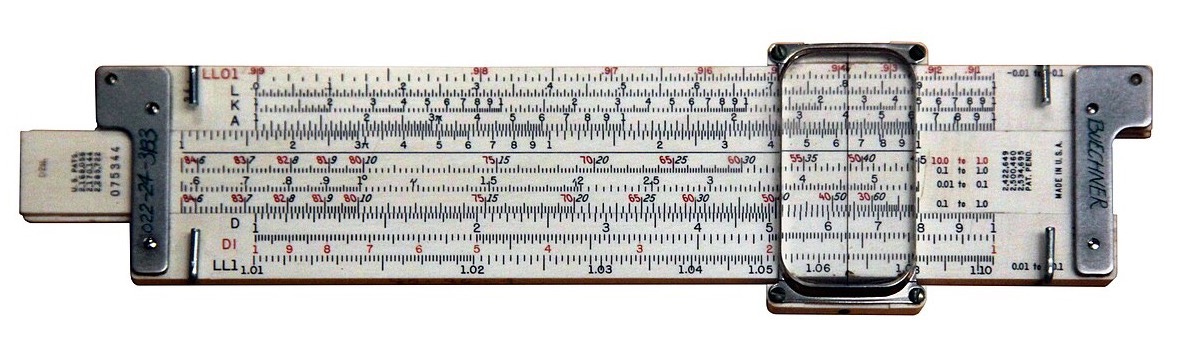
For the next several centuries, the slide rule dominated. I have two on my shelf. Engineers wore them on their belts from the late 1800s through the 1960s the way doctors wear stethoscopes. Then Hewlett-Packard introduced the HP-35 in 1972, and within a decade the slide rule was gone. Three and a half centuries of dominance, ended in ten years. When I mention slide rules on Zoom calls with clients under forty, I get blank stares. The device that designed the Golden Gate Bridge has become unrecognizable in a single generation.
Meanwhile, the calculator kept shrinking. In 1975, the Pulsar strapped arithmetic to your wrist. By the mid-1980s, Casio crammed calculators and contact lists onto a watch face. Marty McFly wore one in Back to the Future. Every math teacher in America told their students, “You won’t always have a calculator in your pocket.”
Those math teachers were wrong. But not in the way they expected.
In 2007, the iPhone shipped with a built-in calculator app. Two billion people now carry one. Nobody thinks about it. Then Siri and Alexa added another layer. “Hey Siri, what’s 18% of $247?” The calculator didn’t just lose its screen. It lost its body entirely. It became a voice in the air, waiting for a question.
And then it became something else altogether.
The Calculator That Thinks
March 2026. I’m sitting in the same room where the HP-12C and the slide rules keep watch from the shelf. I have four AI agents running simultaneously through OpenClaw, my experimental agent network. They’re working on different tasks, reporting to each other, rolling up to a manager agent. These aren’t calculators. They’re reasoners.
In July 2025, an AI system achieved gold-medal-level performance on the International Mathematical Olympiad, matching the world’s best human mathematicians. Not as a specialized math engine, but as a general-purpose reasoning system that also writes prose, generates code, and debates philosophy. The top frontier models now score 95 to 99% on elite competitions designed to challenge the strongest young mathematicians in the country.
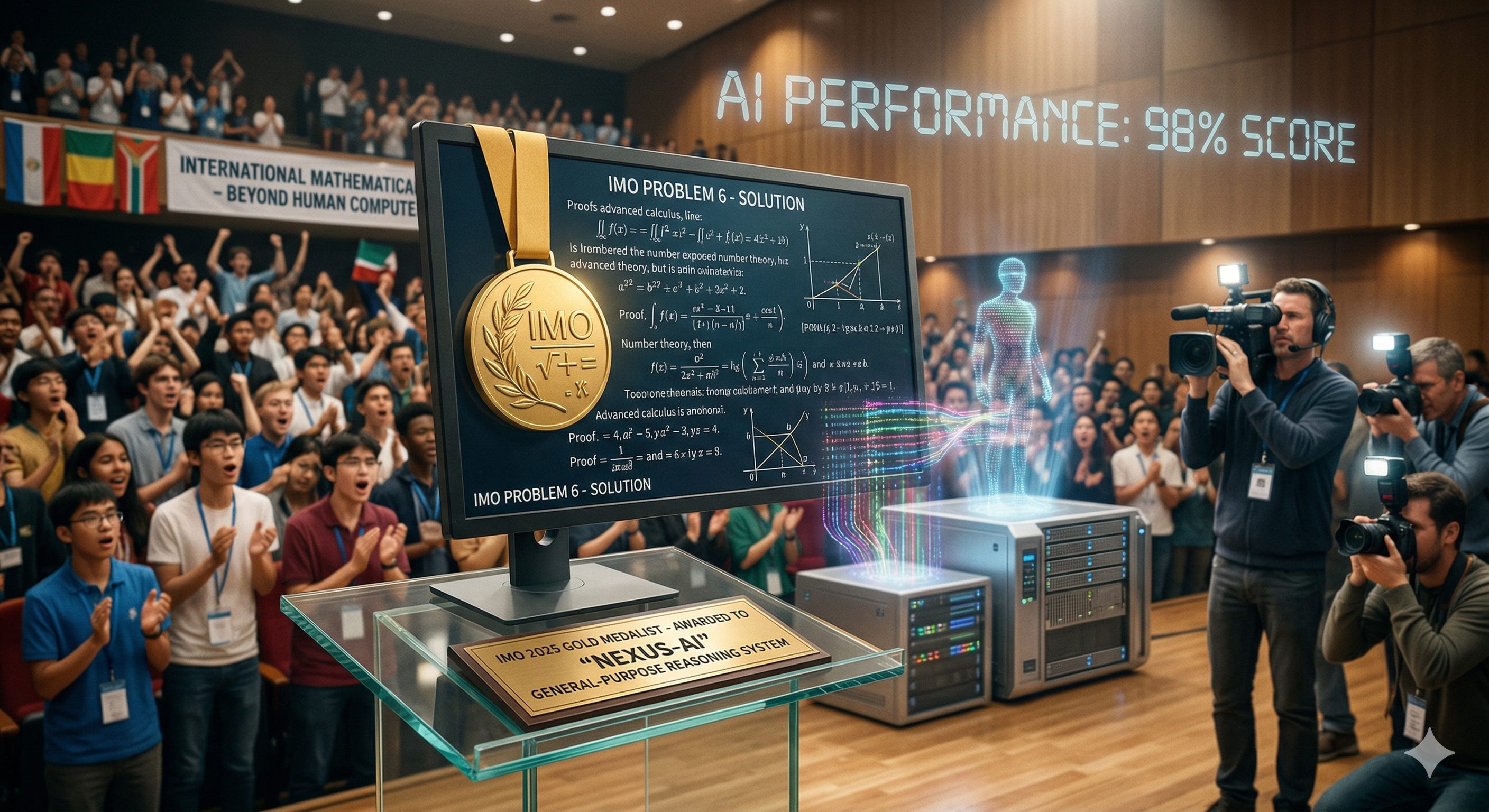
Competition math is effectively solved.
If I need a complex financial formula today, I don’t reach for the HP-12C. I don’t open Excel. I describe the problem in plain English to Claude, and the answer comes back with the reasoning visible, step by step, often surfacing edge cases I hadn’t considered.
The calculation has become a conversation.
Three Patterns, One Story
Here’s what five thousand years of counting teaches us, if we’re willing to see it.
Every new tool absorbs the ones that came before it. The electronic calculator absorbed the slide rule. The smartphone absorbed the calculator. AI absorbs all of them. But with a difference that changes the category.
Every previous tool in this timeline answered a question that a human had already formulated. The abacus tracked quantities. The slide rule multiplied. The HP-12C amortized loans. The tool waited. The human decided what to calculate.
AI doesn’t wait. It reasons about computation. It can figure out which calculation to run, explain why it chose that approach, and suggest what question to ask next. This isn’t a faster calculator. This is a thinking partner. For the first time in five millennia, the instrument examines the problem alongside you, not just the procedure you hand it.
Most people see AI and think “faster calculator” or “better search engine.” That’s like watching the first automobile and thinking “faster horse.”
The displaced become the builders.
Every single time.
Without exception.
The human computers of the 1940s became programmers. The engineers who mastered slide rules designed electronic calculators. The analysts who mastered spreadsheets built SaaS platforms.
I see this in my own life. I was a licensed general contractor before I was a technologist. I built physical structures with wood and concrete and steel. Thirty years later, I’m building digital structures with code and prompts and AI agents. The blueprint became a PRD. The framing crew became a fleet of Claude instances. The inspection became a code review. Different materials, same architecture of thinking.
Right now, accountants who spent decades understanding tax logic are building AI tax agents. Marketers who spent years learning conversion patterns are designing autonomous campaign systems. Lawyers who know contract language are training AI to review documents. The people closest to the work are building the next version of the work.
If you are afraid AI will replace you, here is the five-thousand-year answer: it will replace the task. It will promote the person. But only if you step forward. The human computers who became programmers didn’t get promoted automatically. They volunteered. They learned. They built. The ones who refused to touch the new machines faded from the record.
The fear is always about speed, and it’s always misplaced. HP deliberately kept the HP-12C slow because fast answers felt untrustworthy. Let that sink in. A technology company throttled its own product because human psychology couldn’t keep up with human engineering.
This is happening right now with AI. Millions of intelligent people distrust AI-generated analysis because it arrives too quickly. Too smoothly. Without the visible labor we’ve been trained to associate with credibility. We watch a human analyst spend three days on a financial model and we trust the output. We watch an AI produce the same model in thirty seconds and we hesitate.
But the anxiety was never about accuracy. It was about comprehension. We fear what we can’t watch happening.
Every generation gets past this. Not because the fear was irrational, but because the value of the tool eventually exceeds the comfort of the ritual.
The question is not whether you’ll adopt. The question is whether you’ll adopt early enough to be among the builders, or late enough to be among the replaced.
What We Were Counting Toward
There’s a line that runs from a Babylonian merchant dragging a finger through sand to the AI agent running equations in my home office. It is not a line of speed, although speed has increased. It is not a line of accuracy, although accuracy has improved.
It is a line of liberation.
Every tool freed human attention for something the previous tool couldn’t reach. The abacus freed the merchant to think about trade routes instead of tallies. The slide rule freed the engineer to think about structures instead of logarithm tables. The calculator freed the analyst to think about strategy instead of arithmetic. And each time, the world resisted. Each time, what was actually lost was a limitation masquerading as a skill.
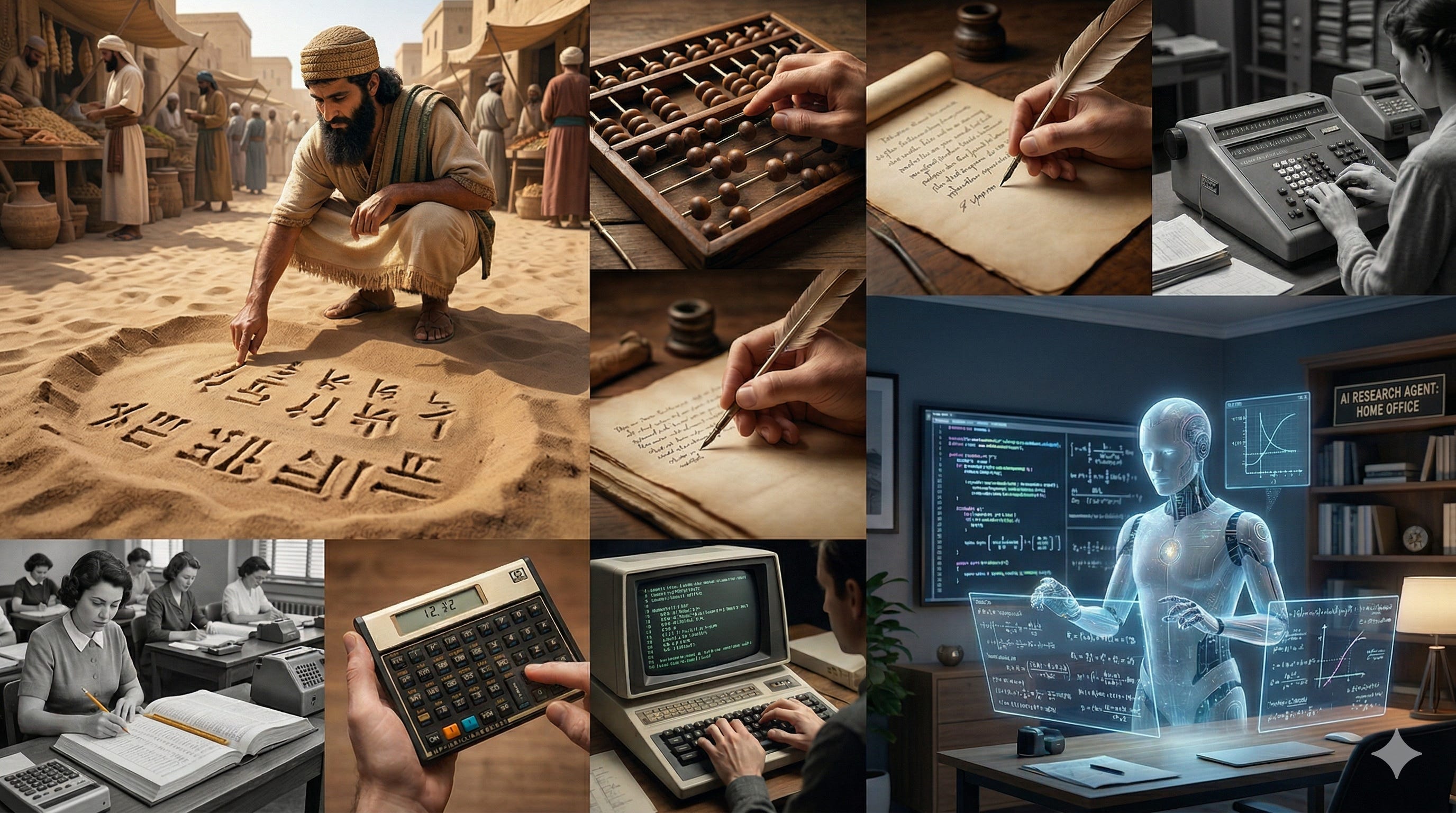
We’ve been outsourcing arithmetic for five thousand years. We’re only now learning that the arithmetic was never the point.
The point was always what comes next. The question only a human can ask. The leap only a builder can make.
My HP-12C still works. Still sits on the shelf. Forty-five years old and $51.95 at Walmart. The last calculator you could hold in your hand and watch thinking.
Everything after it thinks where you can’t see. But everything after it still needs you to decide what’s worth thinking about.
That’s not a threat. That’s an invitation.
What are you going to build?
Deven Spear is a serial founder, builder, and futurist with 30 years at the intersection of technology disruption and human potential. He writes about exponential change, pattern recognition, and the builder’s path at deven.blog. Subscribe for new essays where ancient wisdom meets frontier technology.
📝 The Timeline
~3000 BC — Earliest abacus, probably Babylonian
~830 AD — Al-Khwarizmi writes Al-Jabr in Baghdad. Origin of “algebra” and “algorithm”
1613 — First written use of “computer” to describe a person
1620s — First slide rule
1940s — Over 200 women computing firing tables at University of Pennsylvania; ENIAC programmed by six of them
1972 — HP-35 calculator introduced; slide rules begin rapid decline
1975 — First calculator watch (Pulsar)
1981 — HP-12C introduced. Still in production, March 2026
2007 — iPhone ships with calculator app
2011 — Siri. Calculator becomes a voice
2014 — Amazon Alexa. Calculator moves to your kitchen counter
2025 — AI achieves gold-medal performance at International Mathematical Olympiad
2026 — Frontier AI scores 95-99% on elite math competitions. The calculator becomes a conversation