
At first light, the farmer lifts a crate of tomatoes into the wagon. Dew still clings to the stems. The road ahead is rutted, the sky half-awake. They move toward the market — not an idea, but a place. Wood stalls, open air, the sound of bargaining. Every crate a message, every exchange a signal.
This is the origin of “marketing”. Before brand managers, before dashboards, before even the word “advertise.” To go to market was literal: take what you’ve grown, made, or forged — and meet those who value it.
Somewhere along the centuries, that act turned into an industry. We abstracted the hands, the faces, the road. “Marketing” became a noun detached from its verb. Most modern executives use the word daily yet have forgotten what it means: to enter the arena where value meets attention.
Now, after hundreds of years of industrial scaling and digital abstraction, we are circling back to that square.

Strategy: The Original Market Loop
The farmer’s cycle was the first go-to-market model:
(1) Show up. (2) Signal value. (3) Adapt through feedback.
Presence was credibility. The angle of sunlight on the fruit became packaging. The repeat handshake was loyalty.
This simple loop — visibility, trust, iteration — seeded every future marketing system. Each revolution merely added layers between the maker and the buyer. Industrialization turned those layers into factories, agencies, and distribution networks. The local market became national scale. Trust became logo. Eye contact became copywriting.
But the pattern endured. Marketing has always been about reducing distance — between what’s made and who it’s for.
Case: When the Market Abstracted Itself
By the 20th century, the farmer’s voice was replaced by packaging. Stories became slogans. Presence turned into presence-of-mind. Then came television — the new square. Then came the internet — the infinite square.
Each expansion democratized reach but diluted intimacy. We built scale and lost context. The craftsman disappeared behind the interface.
Today, the interface itself is disappearing.
Inflection: Agentic Marketing and the New Operating System
At Zeta Live 2025, one truth cut through the noise: marketing is no longer a toolset — it’s an operating system.
Nearly 88 percent of marketers now use AI tools daily, up from just 37 percent a year earlier. The conversation has moved past adoption. The new question: Are we ready for marketing where AI doesn’t just assist, but decides and acts?
Zeta’s “Athena” platform demonstrated that shift vividly. The interaction loop sounded almost human:
“You ask. I answer. You approve. I act.”
AI has stopped being an instrument and has become the interface itself.
Dashboards that once described performance now determine it.
Agents analyze patterns, update creative, reallocate budget — all before the morning stand-up.
Marketing’s center of gravity has moved from human intent to machine execution.
And yet, paradoxically, this is the same loop the farmer used — just accelerated by silicon
Pattern: The Two-Surface Economy
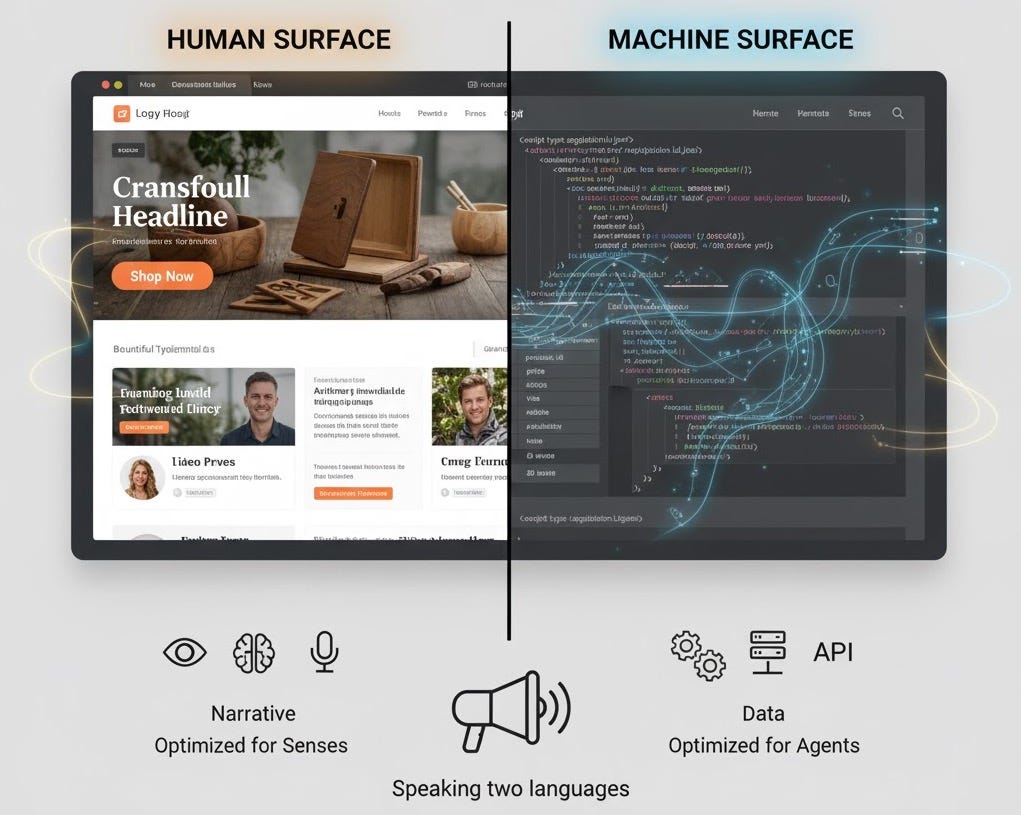
We’ve entered the Two-Surface Economy.
There is the human surface — websites, campaigns, stories written for the senses.
And the machine surface — APIs, schemas, structured metadata written for agents.
In the old square, the farmer optimized for the glance of a passerby.
In the new one, the brand must optimize for both human and machine eyes.
When an AI agent can summarize, evaluate, and purchase without ever visiting your site, the traditional funnel dissolves. Your product must now “speak” two languages: narrative and data.
This is not a loss; it’s a rebalancing.
Human attention still converts.
Machine comprehension now conducts.
Stack: From Barter to Blockchain
Across centuries, the scaffolding of marketing evolved through four eras:

Each era changed the unit of value but kept the same goal — to create liquidity between supply and demand.
Now, tokenized ecosystems and agentic platforms are restoring visibility to the makers again. Smart contracts stand where stall owners once did. Ledger replaces ledger book. Reputation becomes programmable.
The difference is not direction — it’s speed. The feedback loop has collapsed from seasons to seconds.
Ethos: The Regenerative Market
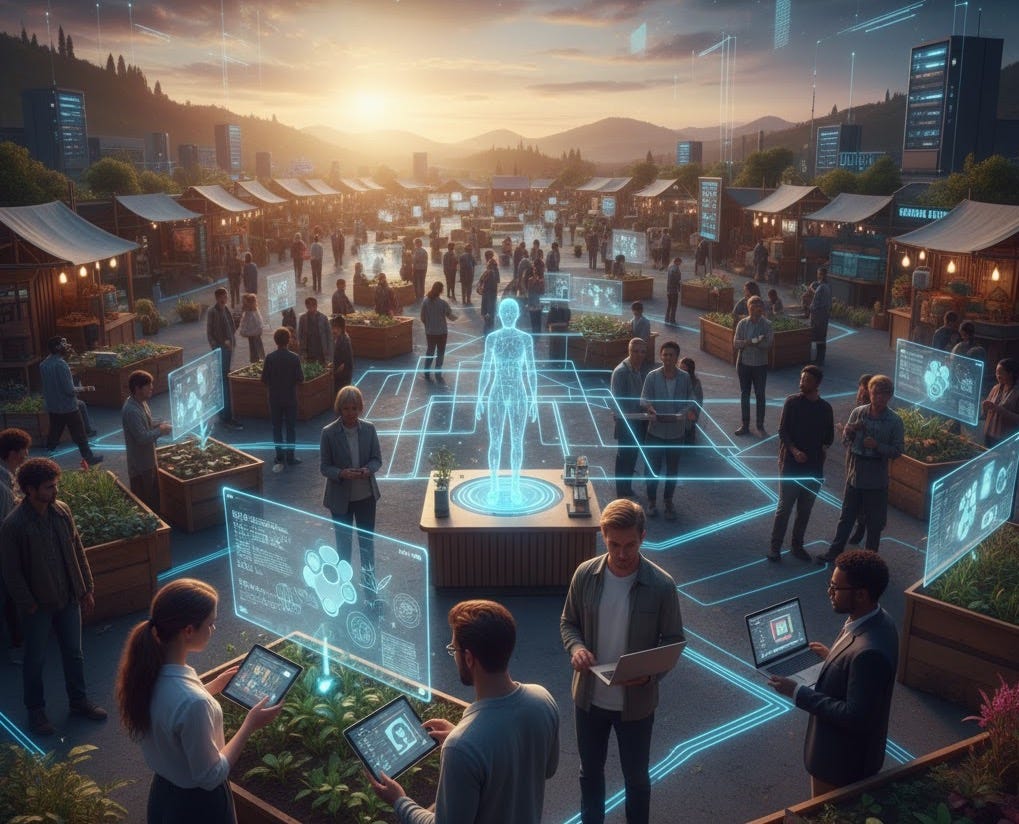
Marketing began in soil. Then it moved to screens. Now it returns to systems.
The next generation of marketers — founders, creators, strategists — will farm again, metaphorically. They’ll cultivate attention soil through authentic signals and harvest trust through transparent systems.
Agentic AI doesn’t eliminate the farmer; it gives them weather control.
It automates repetition so creativity can return to conversation.
The future of marketing isn’t mechanistic. It’s regenerative — built on cycles of data that feed understanding, not just output. Every impression, every transaction, becomes compost for better alignment between creator and community.
Then What: The Call Back to the Market
If marketing started with the farmer, it may end with the founder — returning to the same principle: show up with what you’ve built and engage where value circulates.
The marketplace has become global, instantaneous, and partially machine-run. But the market — the human impulse to exchange, to connect, to be seen — remains unchanged.
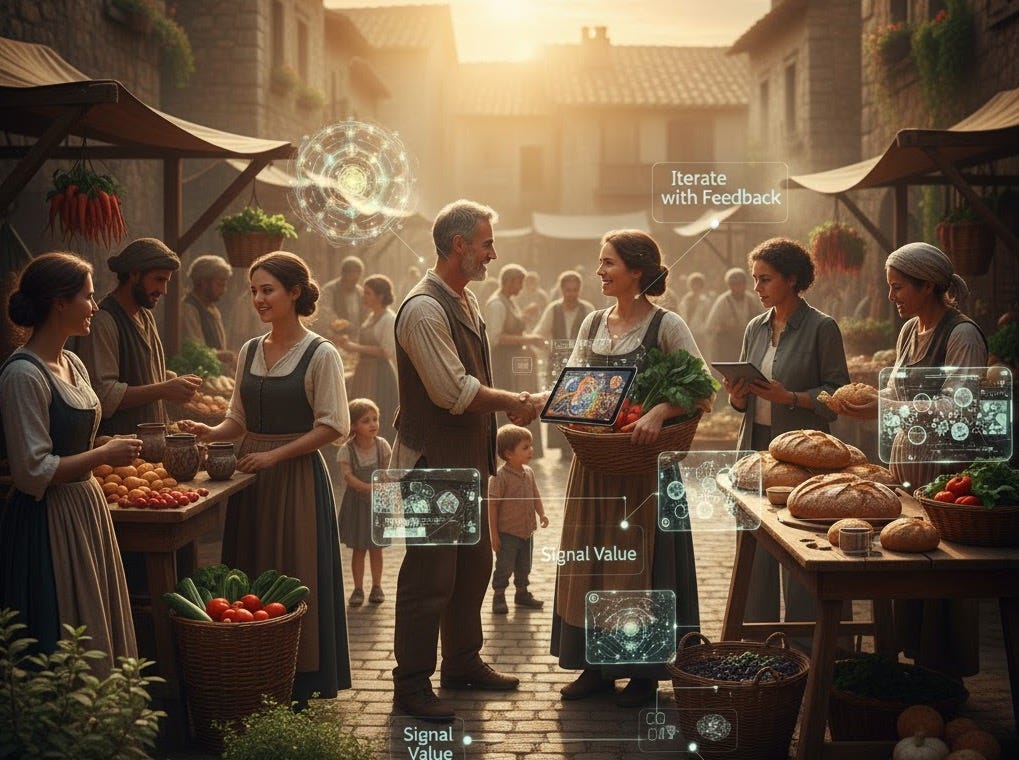
So as AI agents rewrite workflows and redefine attention, the best strategy is still the oldest one:
Show up. Signal value. Iterate with feedback.
That’s not nostalgia. That’s architecture.
This scales. This works.
Ask yourself…
Where is your market square now — your digital field?
Are your signals legible to humans and to agents?
And when the next dawn comes, will you still make the trip to market — or will your agent go for you?